

Board governance, beautifully simplified.
The board portal for boards that run communities.
Minutes, documents, secure messaging and approvals in one simple place. Built for HOA and condo boards, nonprofit boards, board secretaries and property managers.
14-day free trial · credit card required · cancel anytime · board members always free
Rough notes
budget 2026 – maria moved, linda 2nd, 5-1
jw: assessment notices by 4/21
mike dissented on parking
MINUTES OF THE BOARD OF DIRECTORS
April 17, 2026 · Quorum: 6 of 6 present · Called to order 7:00 PM
Motion: Approve 2026 operating budget
Moved: M. Rodriguez · Second: L. Anderson · Vote: 5-1 · Passed
Action item
J. Williams to send assessment notices by Apr 21
Four things a board needs, kept in one place
The things boards keep across shared folders, email chains and a binder, together and easy for volunteers to use.
Minutes in minutes
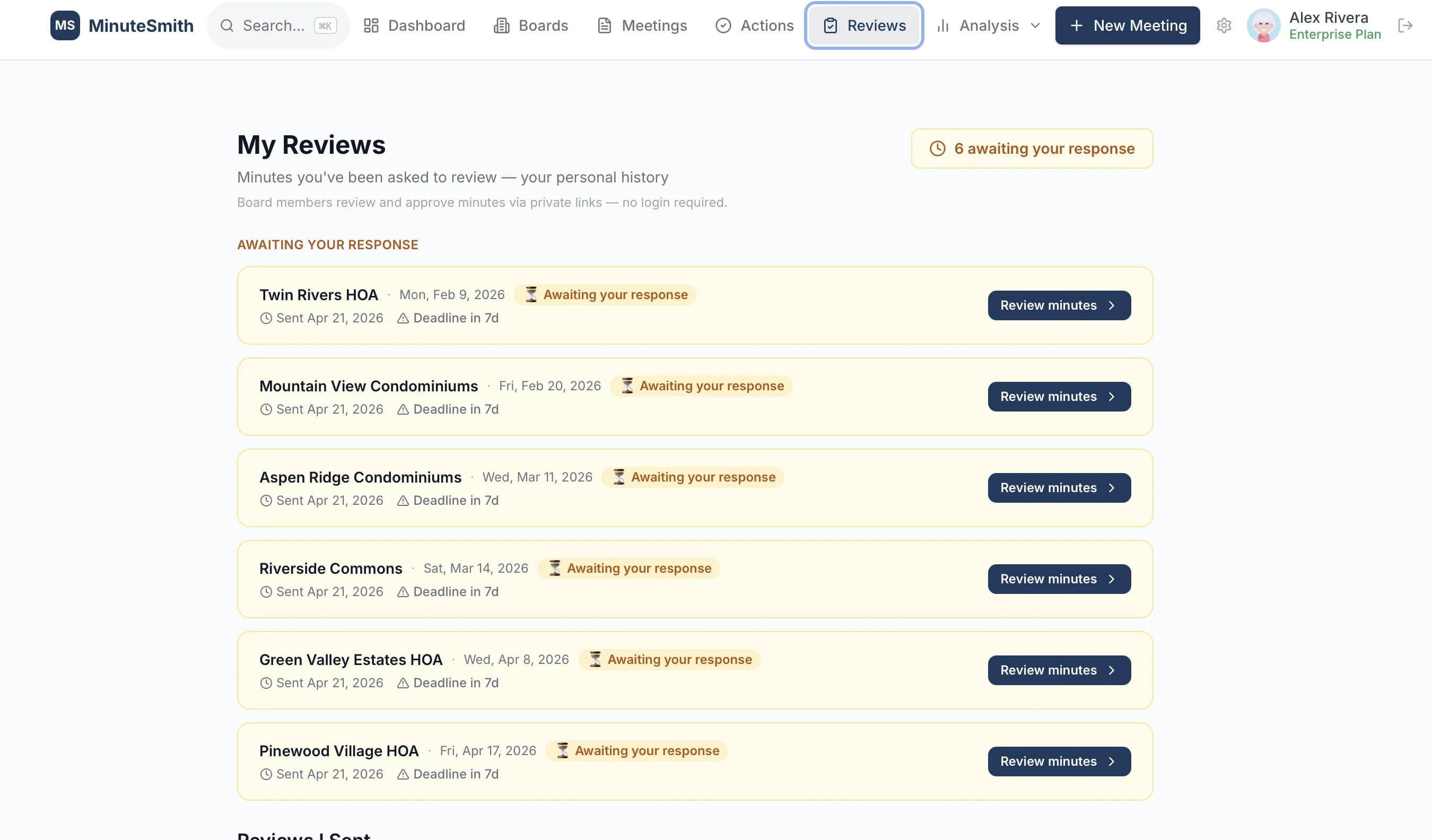
Notes, transcripts or recordings become board-ready minutes. Suggestions, accept or decline, and approval tracking are built in.
How it worksSecure board messaging
Message the whole board, a committee or chosen people. Official notices record who has acknowledged them. Email alerts, and text alerts for members who opt in.
How it worksDocuments and history
Searchable institutional memory: decisions, motions, action items, attendance and files. Ask what the board decided two years ago and get the answer in seconds.
How it worksApprovals and governance
Review and approval workflows, member terms and voting eligibility, officers, committees and attendance standing.
How it worksOne real, anonymized board archive, 2020 to 2026
- Meetings
- 96
- Decisions
- 160
- Motions
- 161
- Actions
- 699
- Years
- 7+
From a pile of rough notes to minutes the board can approve in one sitting
Upload a meeting
Notes, a Word doc, a Zoom or Otter transcript, or a recording.
Get structured minutes
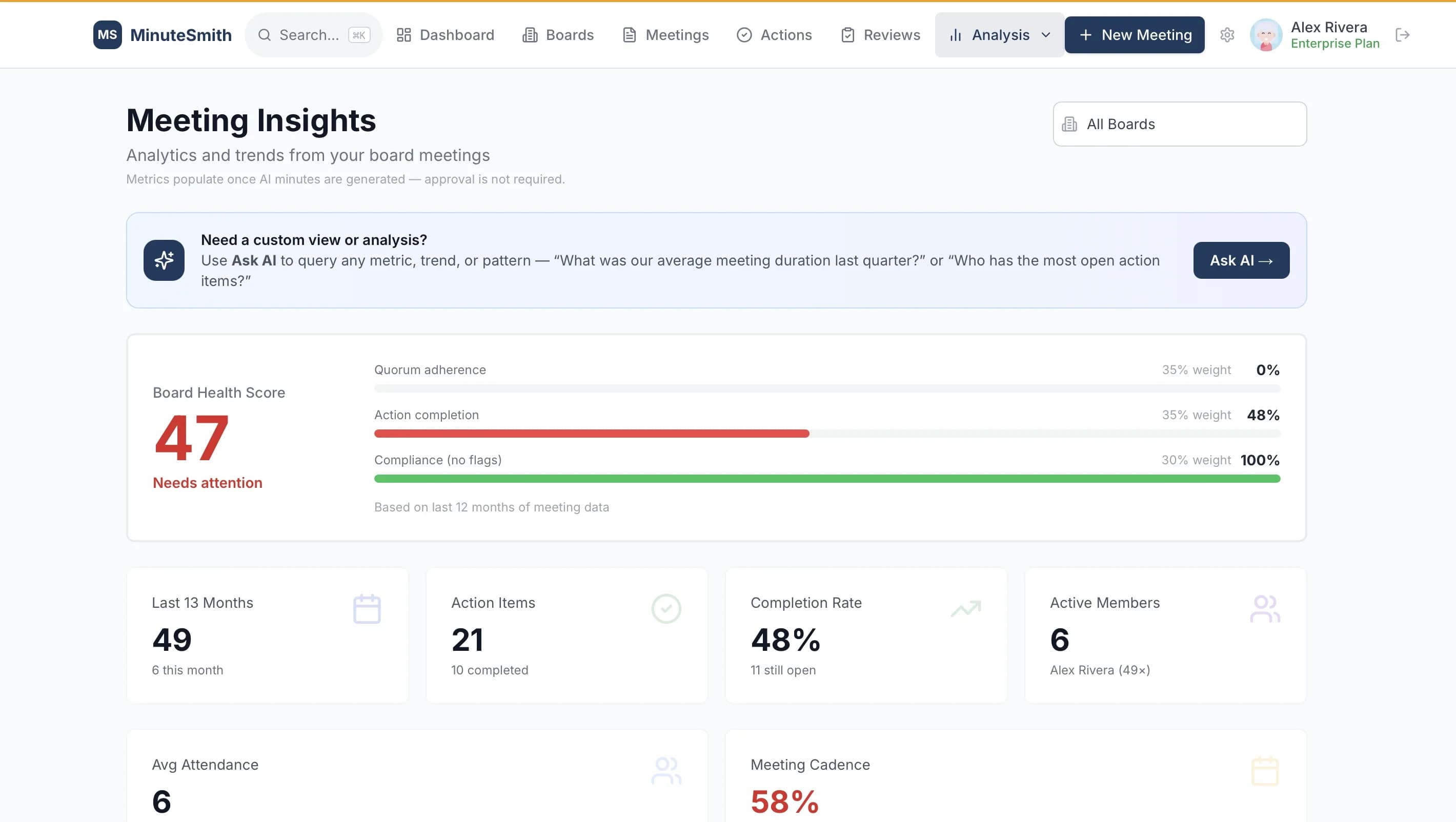
Motions, votes, decisions and action items, checked for quorum and missing votes before anyone approves.
See trends across your boards
Ask the archive what was decided, and get the answer cited to the meeting.
Board members review from a private link, no account needed. They mark each section, flag a concern or suggest a wording, and the secretary accepts or declines each suggestion.
Messages that belong to the board, not to someone’s inbox.
Board conversations stay in MinuteSmith, so when a member leaves, the history stays with the board instead of leaving in a personal inbox.
- Who sees it
- Write to the whole board, a committee or the people you choose. A conversation between members is visible only to the people in it.
- How it is delivered
- In MinuteSmith, where replies and files stay together, or by email to their inboxes, with a preview of exactly who receives it.
- Notices that must be read
- Official notices keep a record of delivery and of who has acknowledged them, person by person.
- Files and alerts
- Attach PDFs, images, Word, Excel or PowerPoint files. Members get email alerts, and text alerts if they opt in.
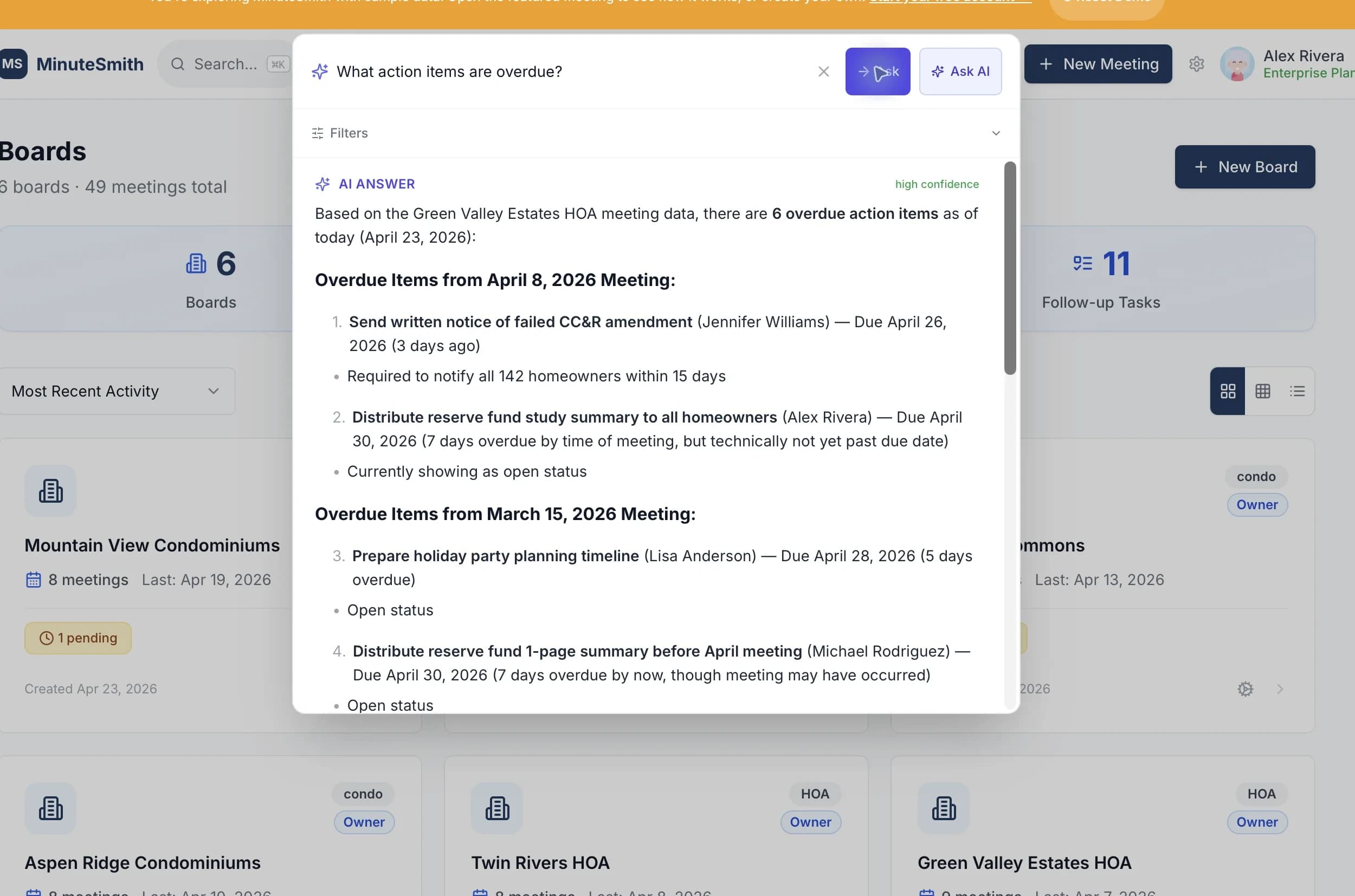
What did the board actually decide about the pool vendor, and when?
Ask in plain English. The answer names the minutes it comes from, so anyone on the board can check it.
Answer · cited to 3 meetings
The board switched to AquaPro Services at $1,850/month, effective when the AquaCare contract expires in August. The decision closed a four-meeting thread:
- Initially raised in the Annual Budget Review (resident complaints about AquaCare).
- An RFP was authorized but responses came in slowly, and David Romano flagged the delay as overdue.
- By the Insurance & Town Hall meeting, two bids were in (AquaPro and CleanWater Co.).
- Approved 7-0 at the Town Hall Recap meeting.
Sources
Ask AI
An answer cited to the meetings it came from, not a list of search results.
The example comes from the Riverbend HOA sample board. With your own board, answers come only from your organization’s records, and your data is never used to train AI models.
Every decision the board has made, by date
Motions are captured from the minutes into one list with the date, the motion and whether it passed. Search it, or switch to a timeline. Files sit next to it: governing documents, minutes and reports, with older versions kept on file.
New to the idea? Read what governance memory is and why it matters for boards.
Already have years of minutes? Bring them.
Drop in a folder of past minutes. MinuteSmith turns each file into a meeting with its attendees, decisions and action items, and indexes it, so Ask AI works across the imported history on day one.
Try it with your past minutesWhat you can import
- PDF and Word documents (.pdf, .doc, .docx)
- Photos or scans of printed pages (.png, .jpg, .webp, .gif)
- Plain text, Markdown and RTF
- Unlimited import on Governance Professional and Portfolio
Approvals, terms and attendance, tracked without a spreadsheet
Each meeting shows where its minutes are: drafted, in board review, at the approval vote, or sent to members. Approved minutes are locked from edits.
MinuteSmith also keeps member terms and voting eligibility, officers, committees and attendance, and shows who is due for a review.
Built to the standard a board expects.
Governance records are sensitive. Each organization’s archive is isolated, minutes are never used to train AI models, and every approved record is versioned.
What we do and don’t claim: Security · Trust Center
Per-organization isolation
Postgres Row-Level Security at the database layer; every query is scoped to your own boards.
Encrypted, US-hosted
TLS in transit, encryption at rest, hosted in the United States.
Audit trail
Approved records are content-hashed and versioned, so you can see who decided what and when.
Run your organization like a real entity
Beyond minutes: MinuteSmith keeps your documented decisions, governance records, and institutional history organized over time. It is governance continuity, not legal advice.
Documented decisions
Resolutions, written consents, and authorized decisions, with who approved them and when.
Governance continuity
A cadence you keep, an organized records vault, and a timeline of how the organization has operated.
A continuity packet
Export an organized PDF to hand to your attorney, CPA, or advisors. It is organized source material, not certification.
Why boards switch
Built for
- HOA & condo boards
- Nonprofit boards
- Property managers
- LLCs, advisory & small corporate boards
- Standing committees
Wherever the record has to outlive the people who kept it.
Instead of shared folders
A folder holds files. MinuteSmith also writes the minutes, tracks approval, and keeps every decision searchable.
Instead of email chains
Board conversations live in threads, not in someone's inbox. They stay with the board when members change.
Instead of an enterprise portal
Enterprise portals are built for large companies. MinuteSmith gives volunteer boards the same essentials without the training or the price.
Designed for boards, LLCs, nonprofits, associations, and committees
- Private AI over your own records
- Answers cite their sources
- US-hosted
- No per-seat pricing
Priced per organization, never per seat.
Board members you invite are always free. 14-day trial, credit card required, cancel anytime.
Governance Essentials · $149/mo
The board portal for a single organization
Governance Professional · $349/mo
Several boards & committees, with readiness & communications
Governance Portfolio · $699/mo
Multi-entity portfolio oversight & parent/child governance
Frequently asked questions
Is MinuteSmith a board portal?+
Yes. MinuteSmith is a board portal for boards that run communities: HOA and condo boards, nonprofit boards and their committees. Minutes, documents, secure messaging and approvals live in one place, and MinuteSmith also drafts the minutes for you from notes, a transcript or a recording.
How is it different from an enterprise board portal?+
Enterprise portals are built for large companies with a dedicated board office. MinuteSmith covers what a volunteer board uses every month, starts with a self-serve free trial, publishes its prices and never charges per board member. If you need formal security certifications, our Security page lists plainly what we do and don't claim.
How is MinuteSmith different from an AI note-taker like Otter or Fireflies?+
Note-takers transcribe and summarize a single meeting. MinuteSmith produces an approved governance record (motions, votes, and action items) and then builds a searchable institutional memory across every meeting, so you can ask what the board decided last year and get an answer cited to the exact minutes.
Can MinuteSmith work with our past minutes?+
Yes. Import existing minutes (PDFs, Word documents, or photos and scans of printed pages) and years of history become searchable right away, so Ask AI works on day one instead of only after new meetings accrue.
How much does MinuteSmith cost?+
Plans start at $149/month (Governance Essentials, one organization), with Professional at $349/month and Portfolio at $699/month. Pricing is per organization, and invited board members are always free, with no per-seat fees. There's a 14-day free trial; a credit card is required and you can cancel anytime before it ends.
Do board members need accounts or pay per seat?+
No. Board members review and approve minutes through a private link without creating an account, and members you invite are always free. You're billed per organization, not per seat.
Is our governance data kept private?+
Each organization's archive is isolated at the database layer, retrieval is scoped to your own boards, and your minutes are never used to train AI models. See the security page for the full posture.